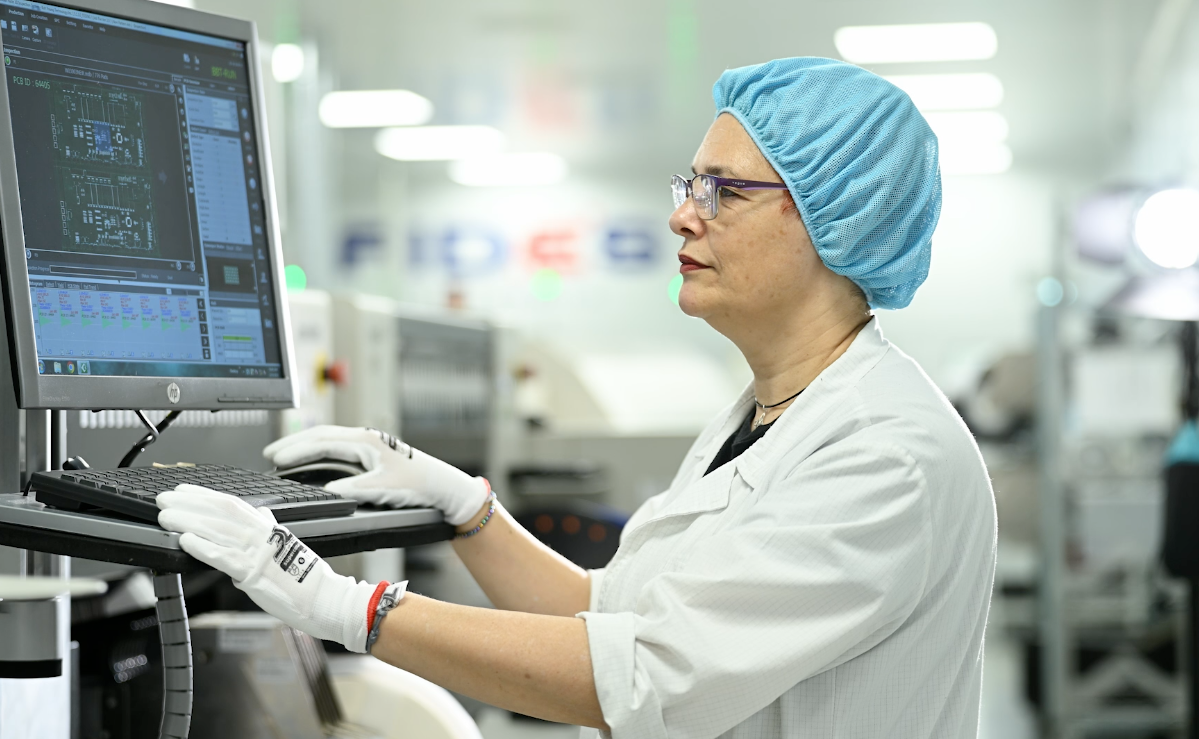
Montar componentes electrónicos de montaje superficial (SMT) exige una precisión extrema.
Un solo pelo o partícula de polvo sobre una placa PCB puede provocar defectos de soldadura o fallos en el dispositivo final. Por ello, la limpieza del entorno se ha vuelto un factor crítico en la fabricación electrónica.
La llamada “sala blanca” o sala limpia es una inversión que garantiza condiciones controladas para minimizar estas contaminaciones.
Un producto electrónico contaminado puede fallar por completo, generando dispositivos poco fiables y de baja calidad. Por esta razón, la limpieza forma parte integral del proceso de fabricación electrónica.
¿Qué es una sala blanca en el montaje SMT?
En el contexto de la fabricación electrónica, una “sala blanca” o sala limpia es un espacio especialmente diseñado para mantener un nivel extremadamente bajo de partículas en el aire.
Estas salas se utilizan en las fases más críticas del proceso de ensamblaje. Una sala blanca cumple estrictas normas de limpieza, asegurando un entorno prácticamente estéril durante el montaje de componentes.
No todas las salas blancas tienen el mismo nivel de pureza. Se clasifican según estándares internacionales(ISO 14644-1)en función de la concentración máxima de partículas permitidas en el aire.
Cuanto más baja es la clase ISO, menos partículas contiene el aire (mayor limpieza). Por ejemplo, una sala ISO Clase 5 (equivalente a Clase 100 en la antigua FED-STD-209E) permite como máximo ~100.000 partículas de tamaño ≥0,1 µm por metro cúbico..
En el sector electrónico y automoción se suele recomendar un nivel ISO 8 y en aplicaciones más restrictivas (médico, militar y otros) se recomiendo un nivel ISO 7. ISO 7.
Fides Electrónica dispone de una sala blanca ISO 7.
Contaminación: El enemigo invisible en SMT
En una línea SMT convencional (sin ambiente controlado) es inevitable la presencia de contaminantes microscópicos.
De hecho, muchas líneas SMT operan en áreas cerradas comunes y no en cuartos limpios, permitiendo la entrada de polvo y partículas que derivan en niveles inaceptables de defectos y retrabajos.
Las fuentes típicas de contaminación en un entorno de montaje incluyen:
Polvo y fibras ambientales
Partículas de polvo en suspensión en el aire, pelusas de los paños de limpieza o fibras de la ropa.
Partículas generadas por el hombre
Cabellos, células de la piel e incluso residuos de huellas dactilares. Un solo operador puede generar hasta 100.000 partículas por minuto simplemente a través del movimiento normal.
Residuos del proceso
Pequeñas trazas de pasta de soldadura seca, polvo de resina de máscara de soldadura, partículas de epoxi o micropartículas generadas durante la manipulación y el embalaje de los componentes.
Otros contaminantes
Partículas introducidas por equipos o materiales, como fibras de cartón de envases, aerosoles o partículas transportadas por carros y ruedas.
Si estas partículas están presentes en la placa de circuito impreso durante la impresión o el reflujo de la pasta de soldadura, pueden provocar numerosos defectos: puentes de soldadura entre patillas, uniones de soldadura frías o débiles, cortocircuitos causados por partículas metálicas y otros problemas.
El resultado son placas defectuosas que requieren reprocesado o rechazo, lo que aumenta los costes y los retrasos. Incluso cuando el defecto no es inmediatamente visible, la contaminación puede generar fallos latentes,que se encuentran entre las principales causas de fallos intermitentes o retardados de los PCB debido a la corrosión acelerada y a la degradación a largo plazo.
Ventajas de una sala blanca en el montaje SMT
La implantación de un entorno de sala blanca en una línea SMT ofrece varias ventajas técnicas y de calidad:
- Menor índice de defectos de soldadura
Al reducir drásticamente las partículas suspendidas en el aire, disminuye la incidencia de puentes de soldadura, componentes mal soldados o defectos relacionados con la contaminación. Esto se traduce en menos errores de reflujo y menos placas de circuito impreso rechazadas.. - Mayor fiabilidad a largo plazo
Un entorno de montaje más limpio aumenta la fiabilidad del producto sobre el terreno. La ausencia de contaminantes como polvo, residuos iónicos o humedad atrapada reduce la corrosión de los conductores y los fallos prematuros causados por la migración electroquímica. - Cumplimiento de normas exigentes
Los sectores críticos, como el médico, el automovilístico y el aeroespacial, exigen estrictos niveles de limpieza para certificar los equipos electrónicos. - Reducción de repeticiones y residuos
Mantener un entorno de fabricación limpio mejora el rendimiento de la producción. Con menos defectos relacionados con la contaminación, menos placas necesitan ser retocadas o desechadas, lo que ahorra tiempo y costes.
Buenas prácticas para el mantenimiento de una sala limpia
La consecución de las ventajas descritas anteriormente no sólo requiere una infraestructura de sala blanca, sino también procedimientos estrictos de control de la contaminación. Las mejores prácticas clave en un entorno de sala blanca SMT incluyen:
- Filtración y circulación del aire
Utilizar sistemas de calefacción, ventilación y aire acondicionado de alta eficiencia Filtros HEPA para capturar partículas microscópicas. Mantener presión de aire positiva dentro de la sala blanca para que no pueda entrar aire sin filtrar. Además, utilice sistemas de aspiración con filtro HEPA en los puestos de trabajo y controle periódicamente la calidad del aire con contadores de partículas. - Limpieza rutinaria de superficies
Establezca protocolos de limpieza estrictos para suelos, paredes, techos, mesas de trabajo y equipos. Todas las superficies y filtros deben permanecer limpios, ya que las partículas pueden depositarse y posteriormente volver a ser aerotransportadas. Las puertas deben permanecer cerradas y el movimiento de personal y materiales debe reducirse al mínimo. - Climatización estable
Mantenga la temperatura dentro del intervalo recomendado para el proceso. Por ejemplo, las salas SMT suelen funcionar en torno a 22 °C ±2 °C para garantizar unas condiciones óptimas de impresión de la pasta de soldadura. - Disciplina del personal
El comportamiento humano es fundamental en un entorno de sala blanca. El personal debe llevar prendas especializadas -como batas o monos antiestáticos, cubrezapatos, cubrepelos y guantes- y seguir estrictos procedimientos operativos y de higiene.
La aplicación de estas medidas garantiza que la sala blanca cumpla su propósito. Sin los protocolos adecuados, incluso las instalaciones más sofisticadas pueden introducir contaminantes y anular los beneficios esperados.
Preguntas frecuentes sobre salas blancas en el montaje SMT
- ¿Qué es una sala blanca en el montaje SMT?
Se trata de un entorno controlado diseñado para mantener concentraciones de partículas extremadamente bajas en el aire con el fin de evitar la contaminación durante el montaje electrónico. - ¿Por qué es importante una sala blanca en SMT?
Las partículas microscópicas pueden provocar defectos de soldadura, cortocircuitos o fallos prematuros en las placas de circuito impreso. - ¿Qué norma regula las salas blancas?
En (ISO 14644-1) clasifica las salas blancas en función del número máximo de partículas permitido por metro cúbico de aire. - ¿Qué nivel ISO se suele utilizar en la fabricación de productos electrónicos?
La electrónica industrial suele utilizar se suele recomendar un nivel ISO 8mientras que las aplicaciones más exigentes suelen requerir ISO 7 o superior.. - ¿Reduce una sala blanca los defectos de fabricación?
Sí. Reduce significativamente las tasas de retrabajo y rechazo al eliminar una de las principales fuentes de contaminación.
Cómo integra Fides las salas blancas para garantizar la excelencia en el montaje SMT
Mantener una sala blanca para montaje SMT es un reto que requiere tanto infraestructura como una estricta disciplina operativa. Supone una inversión significativa en instalaciones y costes operativos, pero para muchas empresas los beneficios justifican plenamente la inversión al mejorar la calidad y fiabilidad del producto.
En el caso de fabricantes de series cortas como Fides Electrónicacontar con una Fides Electrónicasala limpia demuestra un compromiso absoluto con la calidad. Sectores como los electrodomésticos profesionales, la movilidad eléctrica, dispositivos médicos, y soluciones HVAC confían sus proyectos a quien pueda garantizarles que cada PCB ha sido ensamblada bajo condiciones óptimas.
En un mercado cada vez más exigente, una sala blanca marca la diferencia. Garantiza que incluso el componente más pequeño se trate como misión críticaaplicando los más altos estándares de limpieza para que cada placa que sale de la línea de producción alcance la máxima calidad y rendimiento.